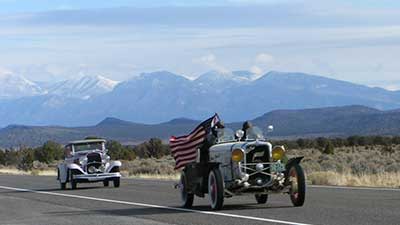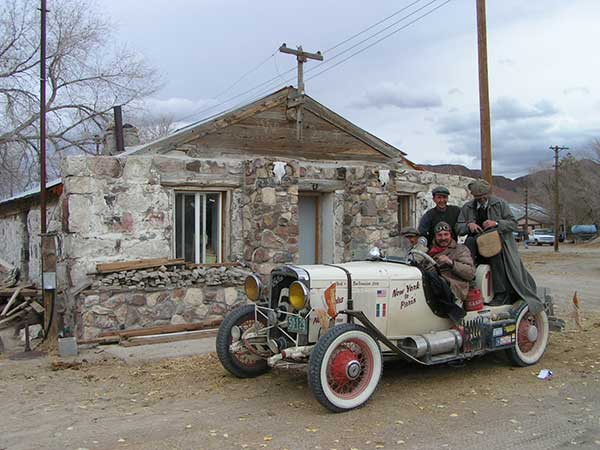
Luke Rizzuto was one of the people who thrilled when a centennial re-creation of the Great New York to Paris automobile race was announced.

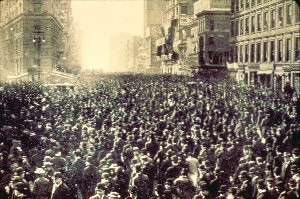
He has a rare 1918 Chevrolet touring car with an overhead valve V8 engine — that’s right, Chevrolet made this engine from 1917 to 1919 and then abandoned it until 1955 — and he wanted to drive it across country following the route of the winning Thomas Flyer in 1908. So he set about seeking sponsors to defray the substantial cost to participate.
 This video was made when Luke was trying at attract sponsors. When the race organizers went bankrupt, he decided to make the run anyhow. |
However, the organizers of the event became disorganized and eventually they cancelled their event. But Luke still wanted to do it. He didn’t want to do it alone — how can you recreate a great race with just one car? — so he passed the word around. With the help of his wife he set up a website, inviting like-minded car lovers to join him. No fees to pay, no organization to maintain, just get yourself and your car to a hotel in New Jersey on October 17 and be ready to pay your own expenses.

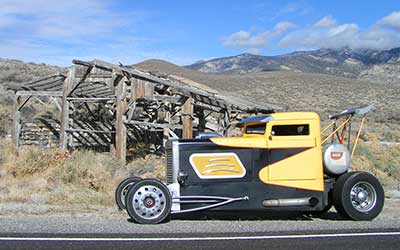

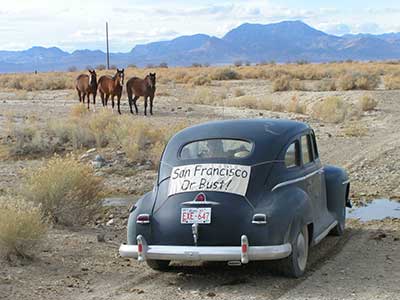
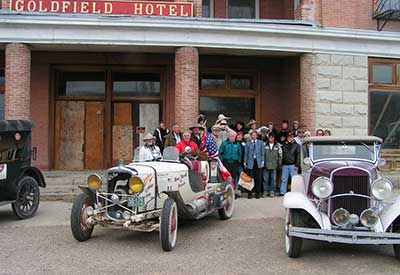
This was the hometown of George Schuster, the intrepid mechanic who kept the Thomas Flyer in good repair until it reached Ogden Utah. There he was handed the keys and promoted to driver for the rest of the journey. It was also one of the few places along the way where the modern drivers were greeted with more enthusiasm than curiosity, as some 700 school children waved American flags when the old cars drove in for a visit.

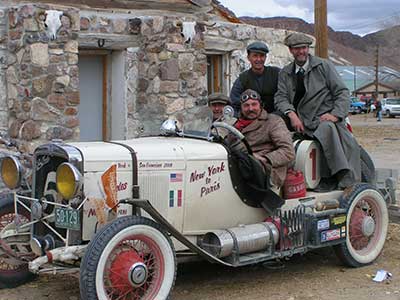
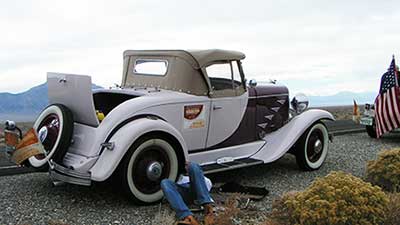
Mechanical difficulties plagued several of the cars, but the most dramatic calamity befell Ray and Pat when the 1930 Chevrolet Speedster lost its throw-out bearing in Montello, in far northeastern Nevada. Efforts to repair it were futile, and replacement parts were unavailable (although someone suggested that Walt, at the Birch Brothers Garage in Ely, might be able to help), so they did what you have to do in that situation: they jammed it into gear and drove on.
 A new documentary about The Great Race is being produced in Canada. |
Unable to shift gears, they finessed the traffic lights in Wendover, and weathered the rain that crashed down as they pressed on to Ely.
The rain had stopped when they pulled into the parking lot behind the Hotel Nevada, but Walt couldn’t be found so they went to Sportsworld to buy a hockey puck in hopes of fabricating a new bearing. To their astonishment, this big sporting goods store doesn’t stock hockey pucks. “In Canada every store has hockey pucks,” they told me.

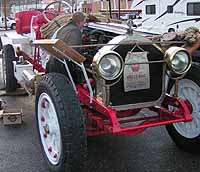
A second call to Walt was successful, and they explained they needed a throw out bearing for a 1930 Chevrolet Speedster. Silence, and then Walt said, “I think I have something that will work.” They hurried down
Aultman Street to the garage, but Walt wasn’t there. Spirits sinking, they waited . . . and waited . . . until Walt appeared holding the throwout bearing for a 1930 Chevrolet Speedster. “Is this what you’re looking for?” he asked.
Another hour on the wet asphalt under the car and the speedster was as good as new.

I learned a lot about the 1908 race of course — George Schuster’s great-grandson Jeff Mahl was a part of the group — and I learned some more about getting off the pavement in remote areas of Nevada too. US 6 is the direct route between Ely and Tonopah these days, but it didn’t exist when the Thomas Flyer came careening across the landscape here. Schuster and his companions had gone west from Ely to Hamilton, and then south following rutted wagon roads from ranch to ranch.
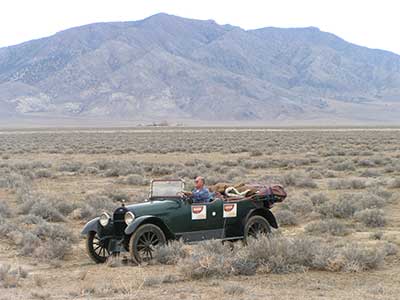
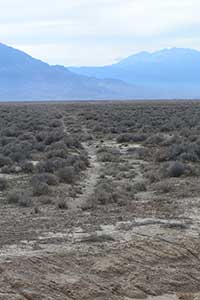

But then the car goes back up on the trailer again as we resume our progress across Railroad Valley. 
The Flyer came this way too. This ranch house, moved first from Belmont to the long-vanished mining town of Liberty, and then here in 1904, greeted Schuster back then, but he didn’t linger long and neither did we.
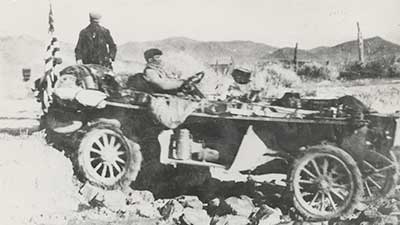
Good grief. Now what? He bought an old gray horse for $20 and set out at dusk for Tonopah where he knew there was at least one other Flyer he could rob parts from. But he got lost in the darkness and happened across Stone Cabin. His knock brought a woman with a shotgun to the door. She was alone — the other folks from the ranch had gone to Tonopah to await the arrival of the racers. She wouldn’t let him into the cabin, but directed him to a corral for his horse and a rough leanto for himself.
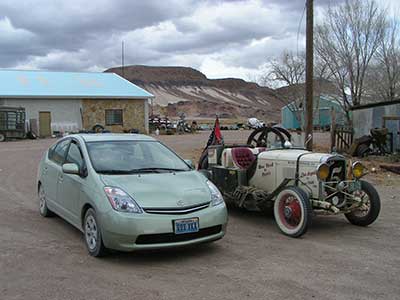
One of the highlights of the visit was locating the exact point at which the Flyer had foundered in the creek that winds through the ranch. Rancher Joe Fallini not only greeted us hospitably, pointing out the structures that had been here in 1908, he also pried open the doors to an old shed to reveal the Model T his father had given him many years before. For an audience of car lovers it was like unveiling the Mona Lisa.