


by Dick Dreiling
The original image of Last Chance Joe was designed in 1952 by Roscoe E. “Duke” Reading of Boise Idaho for Dick Graves.
NOW Available
|

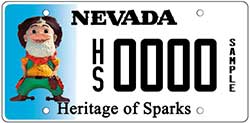
At that time, Richard L. “Dick” Graves owned the Last Chance Café in Garden City, ID, an independent city in the NW part Boise. This image was used for several years in local advertising.
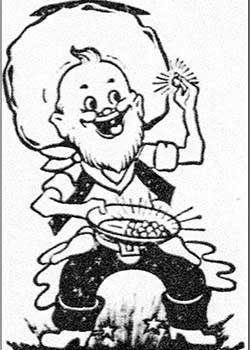

His first Nevada casino was established when he bought the Eagle Club and Café in Yerington which he renamed the Nugget.
In early 1953, the Nugget in Reno was opened by a group of local investors headed by realtor John Hickok. The location at 233 N. Virginia Street was the original location of the Piccadilly Club. In late 1953, the Reno Nugget was purchased by Dick Graves and Jim Kelly.
In February 1954, Dick Graves leased Broderick’s Bar and the Mint Café in Carson City. He combined the two and opened the Carson Nugget on March 1, 1954. Graves was also considering attempting to acquire facilities in Fallon for another Nugget, but that project was shelved.
The gold miner version of Last Chance Joe was utilized in advertising at all of the renamed Nugget casinos.
Dick Graves’ practice was to open a casino, get it well-established, then sell it and move on to another town. When he decided he wanted to open a casino in Sparks, Jim Kelly wanted to stay in Reno, so on January 1, 1955, Graves sold his share of the Reno Nugget to Jim Kelly.
On December 14, 1954 it was announced that Dick Graves was to open the fourth Nugget Casino in Sparks. The location was to be 1144 B Street (now Victorian Avenue), the previous site of Western Mercantile. The new casino was to be basically patterned after its big brother in Carson City. After remodeling, the club opened on March 17, 1955 with 50 slot machines and a 60-stool café.

Desiring to make the Last Chance Joe character more than just a printed advertisement inclusion, Graves sent sketches of Last Chance Joe designed by Roscoe “Duke” Reading.to the Rempel Manufacturing Company to check on the feasibility of manufacture and price each for a few thousand squeeze toys available for sale.
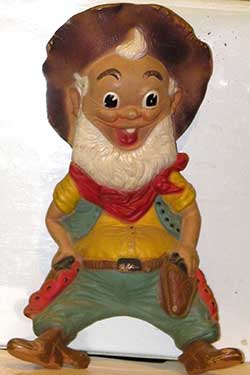

The figure had to be slightly redesigned to remove the outstretched hand holding the nugget and the other hand with the gold pan. Graves agreed and received the dolls he needed for his gift shop.
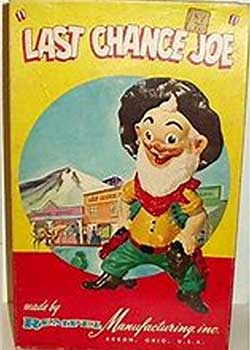
“I commissioned Duke to come up with some kind of a character we could use, and he created Last Chance Joe. We eventually had rubber dolls made that were about twelve, fourteen inches high and we sold tens of thousands of these dolls. It was a good character, sold for one dollar.”
Rempel went on to sell many thousands of the figures nationwide with a blank hat and Graves sold his with the “Nugget” emblazoned hat. Last Chance Joe became one of the best-selling toys produced by Rempel.
Back in Sparks, by June 1955, Graves had acquired and remodeled the site of Peterson’s Drug Store into an expansion of the original Sparks Nugget adding another 2500 square feet of floor space.
Meanwhile at the Carson Nugget, Graves had a four-foot high wooden figure made of Last Chance Joe. The figure was used in many publicity events. In 2008, the figure was sold at an auction of Nugget memorabilia for $700.
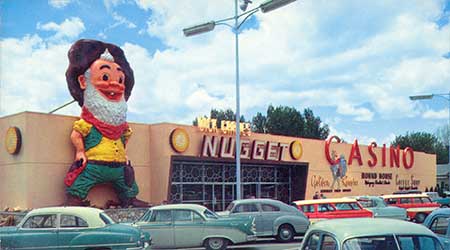
In September 1957 in a newspaper announcement regarding the building of a new casino across the street from the original Nugget, Dick Graves reported there would be a 35 foot figure of Last Chance Joe on the front of the new building.
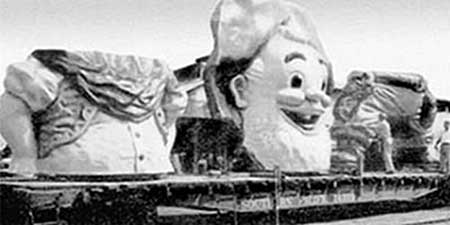
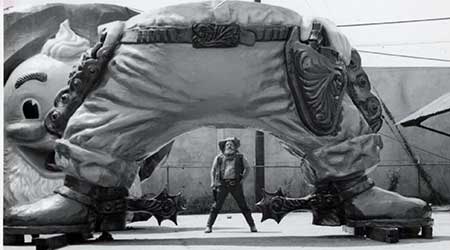
Construction of the figure was assigned to R. L. Grosh & Sons Scenic Studio in Hollywood, CA. Since the design and construction would entail many different disciplines, Tru-Roll Corporation and Pacific Promotions Company were enlisted to assist. The figure was built with a structural steel internal frame which was then covered in chicken wire and papier-mache to build out the various features. It was then covered in a glass cloth called Celastic, painted, then sealed with a plastic spray.
Celastic is a generic name for a plastic impregnated fabric which becomes moldable and adhesive when activated by immersion in solvent or with heat. When dry or cool, it is tranformed into a light-weight, high-impact, weatherproof ‘shell’, having excellent shape memory and bonding power. Celastic can be drilled and will accept many finishing techniques.

Little did we realize what Dick Graves did for Sparks (Tongue firmly in cheek). A September 29, 1959 article in the Idaho State Journal, Pocatello, ID reported: “An Idaho Restauranteur Brought a Nevada Ghost Town to Life – Three years ago Sparks, Nevada was a dead burg. An old Southern Pacific railroad junction, it died with Dieselization. But by last week Sparks was one of the liveliest ex-ghost towns in the West. Reason: A human whirlwind named Dick Graves had blown into town, taken over, and turned Sparks into Nevada’s Restaurant Row.”
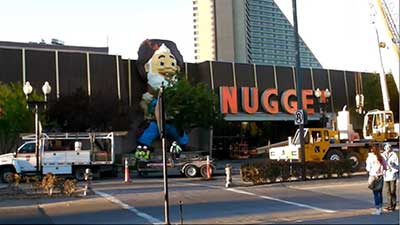

In January 1993, Young Electric Sign Co. was tasked with the job of repairing the face of Joe when a section of the left side of his face fell off due to severe winter storms. In February 1994 during plans for a major redevelopment of downtown Sparks, the Nugget was going to expand and redesign the north, east and west sides of the Nugget to fit in with the planned Victorian theme for B Street (which was to be renamed Victorian Avenue), the Nugget Architect Peter Wilday said the Nugget was going to move Last Chance Joe. He had no idea where Joe would end up, but reassured all that the Nugget would find a suitable spot for him. That move did not happen.
Roscoe “Duke” Reading, Last Chance Joe’s designer passed away on March 28, 1990.
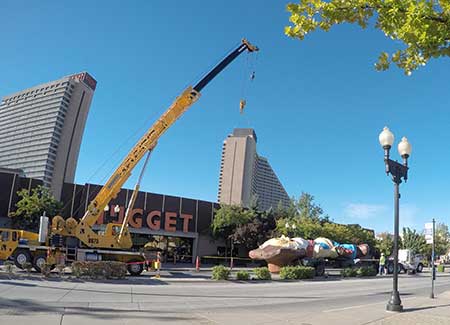

The Board suggested that if Joe was to be moved, a better location would be in front of the Museum as that would provide better visibility for him. Councilwoman Ratti got another bid of about $36,000 to remove him and install him in front of the Museum. She also received a pledge from a not-to-be-named donor to cover all of the costs of the move. The Museum began raising funds for the restoration of the figure. The initial estimates of the restoration was to be around $20,000 to $25,000. Unfortunately, the anonymous donor gave only a $6,000 check then departed the area.
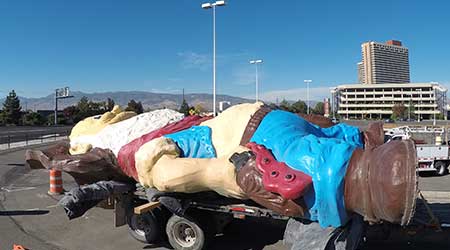
By December 2, 2014, Joe was reinstalled in front of the Museum. During a subsequent inspection of Joe conducted by Will Durham, the designated restorer, revealed that the cost of the restoration would be much higher than originally estimated. This was primarily due to the fact that the 56 year-old figure had never been built with the idea of ever being moved. In addition, Joe had been poorly patched and partially repainted several times. His original green trousers and vest had been changed in color to a shade of blue. His skin tones had been subtly changed to almost match the color of his shirt.
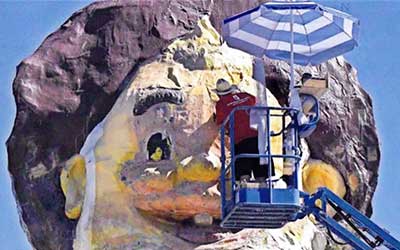
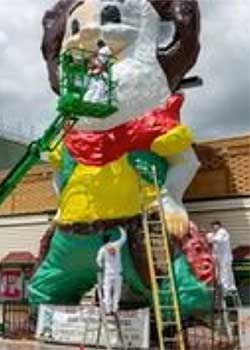

Problems arose over permits, bonding, insurance, etc. that delayed the finishing of the restoration work so ably accomplished by Crown Painting. Last Chance Joe’s dedication and Homecoming Celebration is scheduled for June 22.

