In Nevada, even in our Age of Tesla, it is still possible to venture as deep into history and prehistory as you care to go. Here’s a day trip from Ely or Eureka that will take you off the pavement and into the scenery, out of sight of the modern world.
To do this, bring the survival essentials: digging implements, jacks and wrenches, fluids, and the 3 Bs: blankets, books and beer.
Then get yourself onto US 50 where the Green Springs Road takes off to the south at the far eastern edge of Newark Valley. If you’re coming from Ely that means driving about 10 miles west of the marked road to Illipah and Hamilton until you see the sign pointing south toward the Belmont Mill and Green Springs. That’s where you turn. Coming from Eureka you’ll see the turn-off just before the road begins its climb to Little Antelope Summit.
The Great Automobile Race came this way in 1908, with mechanic George Schuster at the wheel of the Thomas Flyer leading the pack from Ely to Tonopah, San Francisco and Paris via Hamilton and Railroad Valley. But we are not in a race, and with stops for photographs we take a half hour to get to the Belmont Mill.
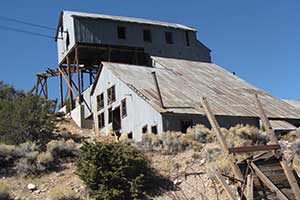
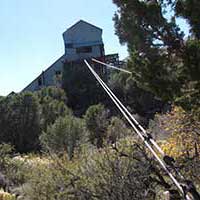
The mill is not named for the community northeast of Tonopah, but for the company that built it in 1926. The Tonopah Belmont Development Company was a major mining company with properties in Tonopah and Goldfield, which by then were in decline. The mill was built using parts and machinery scavenged from the company’s operations there.
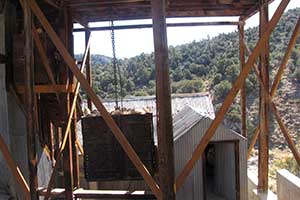
The structure is a rare survivor from those earlier times, relatively intact with the major exception of the Power House that stood next to it with a huge diesel engine inside. This supplied the motive power that turned the wheels to activate the gyres, the gimbals, the aerial tramway with buckets dangling, the paddles in the big cyanide tanks turned by belts, even the electric light bulbs overhead.
The engine turned a shaft that extended from the powerhouse into the mill itself and turned the gears that kept the aerial tramway reliably delivering ore from the mine, one bucketful at a time, no matter what the weather.
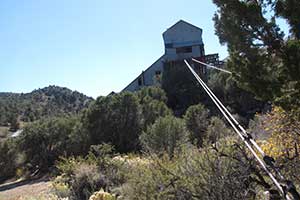
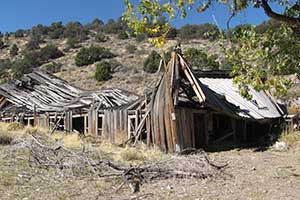
We prowled around separately, figuring things out as we went. Mercifully, there are no informational plaques to interfere with the experience.
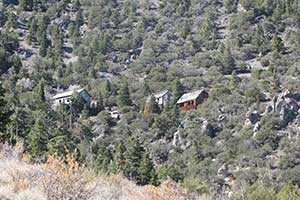
It’s a good road, but near the top there is a narrow squeeze between the steep cliff on one side and the abyss on the other. It’s quite passable but somewhat discombobulating if you are susceptible to altitudinal-disparity discombobulation.
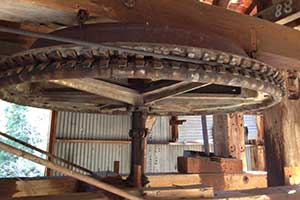
Here we explored the upper terminus of the tramway and followed the trail of the ore from the portal of the mine down to the structure where the cable was pulled around and sent back down again with its buckets full. Their extra weight minimized the amount of energy needed to operate the system.
We clambered around snapping photos, marveling over our discoveries and wondering out loud. By the time we headed back down the mountain we had thoroughly devoured and digested the place without knowing a single thing about it.
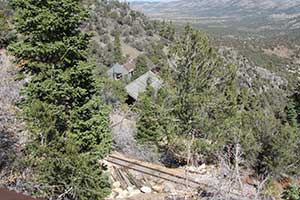
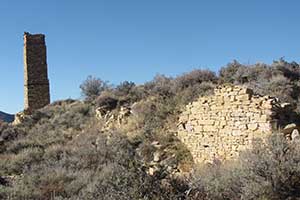
Treasure City grew up there naturally enough. But “natural” at 8,700 feet in these mountains includes no water, freezing winters, avalanches, fierce gales, no firewood, uncertain travel and no services.

“Treasure City has ten months of winter and two months of exceptionally cold weather”, somebody pointed out, and a townsite was platted on more or less level ground at the foot of Treasure Hill’s north side, 900 feet lower down.
In June 1868 a saloon, Hamilton’s first frame structure, was built to accommodate the 30 residents living around it in tents. Assays of the ore from the claims on Treasure Hill showed exceptionally rich values, and the news inspired a hectic “Rush to White Pine”. In August a post office was established.
Over the summer Hamilton grew to accommodate the thousands of hopeful new citizens, some of them coming by train from the east and west coasts, and making their way south from Elko via stagecoach, freight wagon or afoot.
A letter to the Alta Californian from Treasure City in January 1869 stated “there were four deaths [here] on the 9th inst. The weather is very severe, and several persons have been badly frozen. Board is from $15 to $18 per week, exclusive of lodging, which is difficult to obtain at $1 per night. Little or no work is being done on any of the undeveloped claims. Persons anticipating a visit to the new district are cautioned not to do so before spring.”
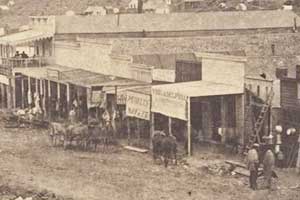
For such a mighty city to suddenly burst into life in that remote place, the mines that supported it must be inexhaustibly rich! Indeed, they had already produced more than $22 million! This would be bigger than the Comstock!
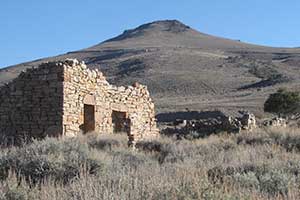
When winter closed in again, though, Treasure City’s business community lost heart. In January 1870 the White Pine NEWS, edited by W.J. Forbes (who had come to White Pine to run a saloon but had fallen back into journalism), moved from its frozen aerie down to Hamilton, joining an exodus of attorneys, brokers of every kind, a wide variety of entrepreneurs, storekeepers and others who preferred staying warm over proximity to the mines.
Over 13,000 claims were located on Treasure Hill in less than two years, although few of them were ever actually worked. From those few, however, silver practically gushed.
Until it didn’t. The mines were rich, but most were shallow, and by the end of 1870 the boom was over. The census that year counted 1,920 residents of Treasure City, 3,913 in Hamilton and 932 in Shermantown.
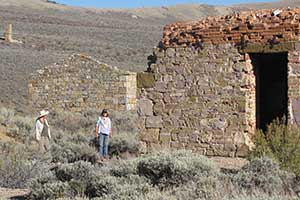
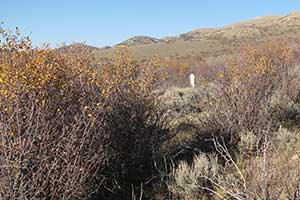
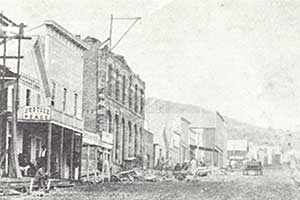
There was another fire at Hamilton in 1885, and this time the Court House burned. In 1887 the White Pine County seat was moved to Ely. That was the end for Hamilton, and it has been falling quietly to pieces ever since. Photos taken in the in the 1950s show the Withington Hotel facade beautifully intact, but now even the ruins have fallen into ruin and what was once the most elegant hotel between Denver and Virginia City is only a pile of bricks.
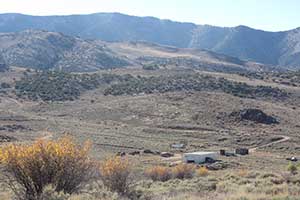
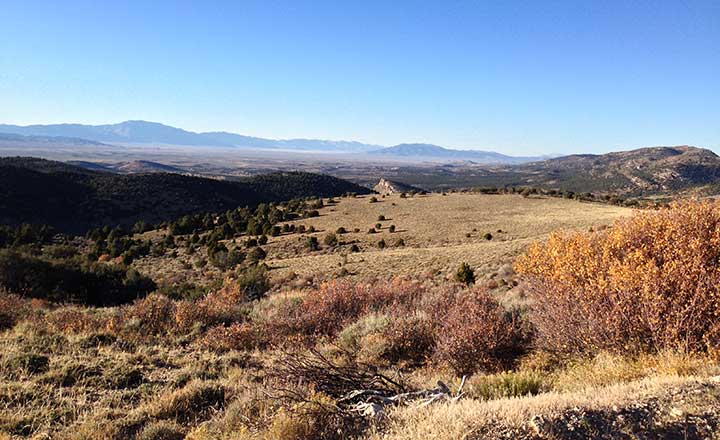
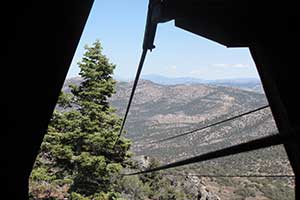
You are seeing the immense sweep of the Newark Valley, with the Diamond Range beyond, about 50 miles of timeless tranquility.